
Exetat d’Anglais et Correspondance Commerciale Anglaise 2024_Commercial de Gestion
Question 1
ENGLISH TEXT
Production is generally in advance of demand and this is very much so nowadays. Too many goods are a source of problems, the immediate consequence of which is the resort to dishonest advertising to sell the surplus articles. Most manufactures and business men, already threatened by number of their competitors, thus make misleading promise and use all kinds of tricks to make people buy in a hurry. They offer winning numbers, cut down their prices, or entice you to buy four packets of cleansing powder, for instance, for the price of three.
The so called winning number is to be cut out, and a form is to be completed and sent to the distributors of the product, and this suffices to enter a big competition. It is marked on the packet that by doing this, you will win a prize. But what is rather doubtful because there can only be a limited number of prizes, and even if a buyer becomes one of the winners, his prize may be an insignificant one, for the number of wonderful prizes is even more limited! Not everybody will win a car or trip to the Virunga Park!
Of course, you are urged to increase the probability of such a doubtful event by purchasing more packets than you are really in need of, because you fear that you might miss a splendid opportunity which, in fact, is highly improbable.
The reduction in price is equally misleading, because it way be a trick to sell poor quality goods, or, more often than not, the price was raised first and cut down afterwards. It may even happen that the customer decides to buy a larger quantity because he believes that the reduction is only a temporary one. Similar trick is to buy four cartons for the price of three. Overbuying completes the vicious circle of overproduction and misleading advertising.
QUESTION ON THE TEXT:
1. According to the first paragraph, business men:
Bonne réponse : d. Give wrong ideas on the qualities and prices of the products.
Explication :
Le premier paragraphe explique que les fabricants et commerçants utilisent des promesses trompeuses, des trucs, et des publicités malhonnêtes pour pousser les gens à acheter.
Ils donnent donc de fausses idées sur la qualité et les prix.
ENGLISH TEXT
Production is generally in advance of demand and this is very much so nowadays. Too many goods are a source of problems, the immediate consequence of which is the resort to dishonest advertising to sell the surplus articles. Most manufactures and business men, already threatened by number of their competitors, thus make misleading promise and use all kinds of tricks to make people buy in a hurry. They offer winning numbers, cut down their prices, or entice you to buy four packets of cleansing powder, for instance, for the price of three.
The so called winning number is to be cut out, and a form is to be completed and sent to the distributors of the product, and this suffices to enter a big competition. It is marked on the packet that by doing this, you will win a prize. But what is rather doubtful because there can only be a limited number of prizes, and even if a buyer becomes one of the winners, his prize may be an insignificant one, for the number of wonderful prizes is even more limited! Not everybody will win a car or trip to the Virunga Park!
Of course, you are urged to increase the probability of such a doubtful event by purchasing more packets than you are really in need of, because you fear that you might miss a splendid opportunity which, in fact, is highly improbable.
The reduction in price is equally misleading, because it way be a trick to sell poor quality goods, or, more often than not, the price was raised first and cut down afterwards. It may even happen that the customer decides to buy a larger quantity because he believes that the reduction is only a temporary one. Similar trick is to buy four cartons for the price of three. Overbuying completes the vicious circle of overproduction and misleading advertising.
QUESTION ON THE TEXT:
2. ….. is to obtain by giving money (or other value).
The correct word to complete this sentence is:
Bonne réponse : c. Purchase
Explication :
Le verbe to purchase signifie obtenir en donnant de l’argent, c’est‑à‑dire acheter.
C’est exactement la définition donnée dans la question.
3. “Where are you” The girl asked her father…
The correct expression to complete this sentence is:
Bonne réponse : d. Where he was.
Explication :
Il s’agit d’un passage du discours direct au discours indirect.
Phrase directe : “Where are you?”
Au discours indirect, on utilise le prétérit → where he was.
Les autres options ne correspondent pas au temps ou à la structure correcte.
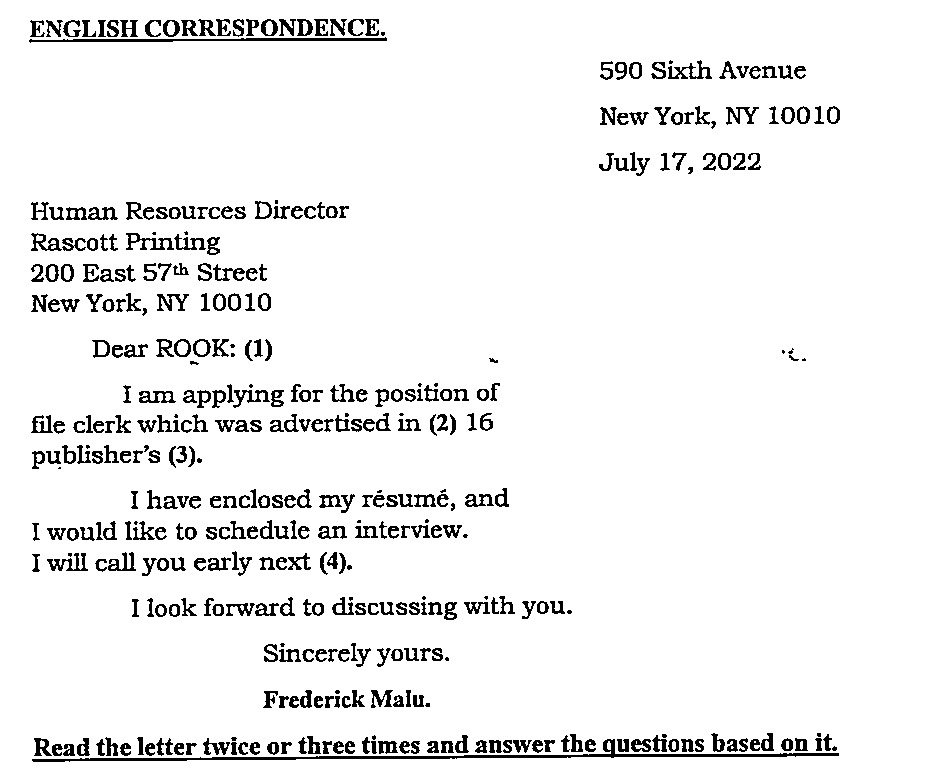
4. The appropriate word to complete the letter part numbered “4” is:
Bonne réponse : e. Week
Explication détaillée :
Dans la lettre, la phrase complète est :
“I will call you early next (4).”
→ L’expression correcte en anglais est “next week”.
Les autres options ne conviennent pas :
My : ne complète pas logiquement la phrase.
monthly : adjectif, impossible ici.
July : ne suit pas “next” dans ce contexte.
Mr : n’a aucun sens grammatical.
Donc Week est la seule réponse correcte.
5. (The) ... consists of the name and address of the addressee.
Bonne réponse : b. Inside address
Explication détaillée :
Dans une lettre commerciale, la partie qui contient le nom et l’adresse du destinataire s’appelle :
➡️ l’Inside address
Rappel des autres parties pour bien comprendre :
Salutation : formule d’appel (Dear Sir…).
Signature : nom et signature de l’expéditeur.
Letter head : en‑tête de l’entreprise (adresse de l’expéditeur).
Closing : formule de politesse finale (Sincerely yours…).
Donc la seule partie correspondant à l’adresse du destinataire est Inside address.
ENGLISH TEXT
Production is generally in advance of demand and this is very much so nowadays. Too many goods are a source of problems, the immediate consequence of which is the resort to dishonest advertising to sell the surplus articles. Most manufactures and business men, already threatened by number of their competitors, thus make misleading promise and use all kinds of tricks to make people buy in a hurry. They offer winning numbers, cut down their prices, or entice you to buy four packets of cleansing powder, for instance, for the price of three.
The so called winning number is to be cut out, and a form is to be completed and sent to the distributors of the product, and this suffices to enter a big competition. It is marked on the packet that by doing this, you will win a prize. But what is rather doubtful because there can only be a limited number of prizes, and even if a buyer becomes one of the winners, his prize may be an insignificant one, for the number of wonderful prizes is even more limited! Not everybody will win a car or trip to the Virunga Park!
Of course, you are urged to increase the probability of such a doubtful event by purchasing more packets than you are really in need of, because you fear that you might miss a splendid opportunity which, in fact, is highly improbable.
The reduction in price is equally misleading, because it way be a trick to sell poor quality goods, or, more often than not, the price was raised first and cut down afterwards. It may even happen that the customer decides to buy a larger quantity because he believes that the reduction is only a temporary one. Similar trick is to buy four cartons for the price of three. Overbuying completes the vicious circle of overproduction and misleading advertising.
QUESTION ON THE TEXT:
1. According to the second paragraph, business men:
Bonne réponse : c. Offer occasions in which buyers are afraid to miss.
Explication :
Le deuxième paragraphe explique que les fabricants utilisent des numéros gagnants, des concours, et des promesses de prix pour pousser les consommateurs à acheter plus que nécessaire.
Ils créent donc des occasions que les acheteurs ont peur de manquer, ce qui correspond exactement à l’option c.
ENGLISH TEXT
Production is generally in advance of demand and this is very much so nowadays. Too many goods are a source of problems, the immediate consequence of which is the resort to dishonest advertising to sell the surplus articles. Most manufactures and business men, already threatened by number of their competitors, thus make misleading promise and use all kinds of tricks to make people buy in a hurry. They offer winning numbers, cut down their prices, or entice you to buy four packets of cleansing powder, for instance, for the price of three.
The so called winning number is to be cut out, and a form is to be completed and sent to the distributors of the product, and this suffices to enter a big competition. It is marked on the packet that by doing this, you will win a prize. But what is rather doubtful because there can only be a limited number of prizes, and even if a buyer becomes one of the winners, his prize may be an insignificant one, for the number of wonderful prizes is even more limited! Not everybody will win a car or trip to the Virunga Park!
Of course, you are urged to increase the probability of such a doubtful event by purchasing more packets than you are really in need of, because you fear that you might miss a splendid opportunity which, in fact, is highly improbable.
The reduction in price is equally misleading, because it way be a trick to sell poor quality goods, or, more often than not, the price was raised first and cut down afterwards. It may even happen that the customer decides to buy a larger quantity because he believes that the reduction is only a temporary one. Similar trick is to buy four cartons for the price of three. Overbuying completes the vicious circle of overproduction and misleading advertising.
QUESTION ON THE TEXT:
2. ….. is to make something known to the public.
The correct word to complete this sentence is:
Bonne réponse : a. Advertising
Explication :
Le verbe to advertise signifie faire connaître quelque chose au public, c’est‑à‑dire faire de la publicité.
Les autres mots ne correspondent pas à cette définition.
3. “Where have you been” The girl asked her father…
The correct expression to complete this sentence is:
Bonne réponse : e. Where he had been.
Explication :
On transforme :
→ “Where have you been?” (présent perfect)
en discours indirect après asked.
Le présent perfect devient past perfect → had been.
La structure correcte est donc :
“The girl asked her father where he had been.”
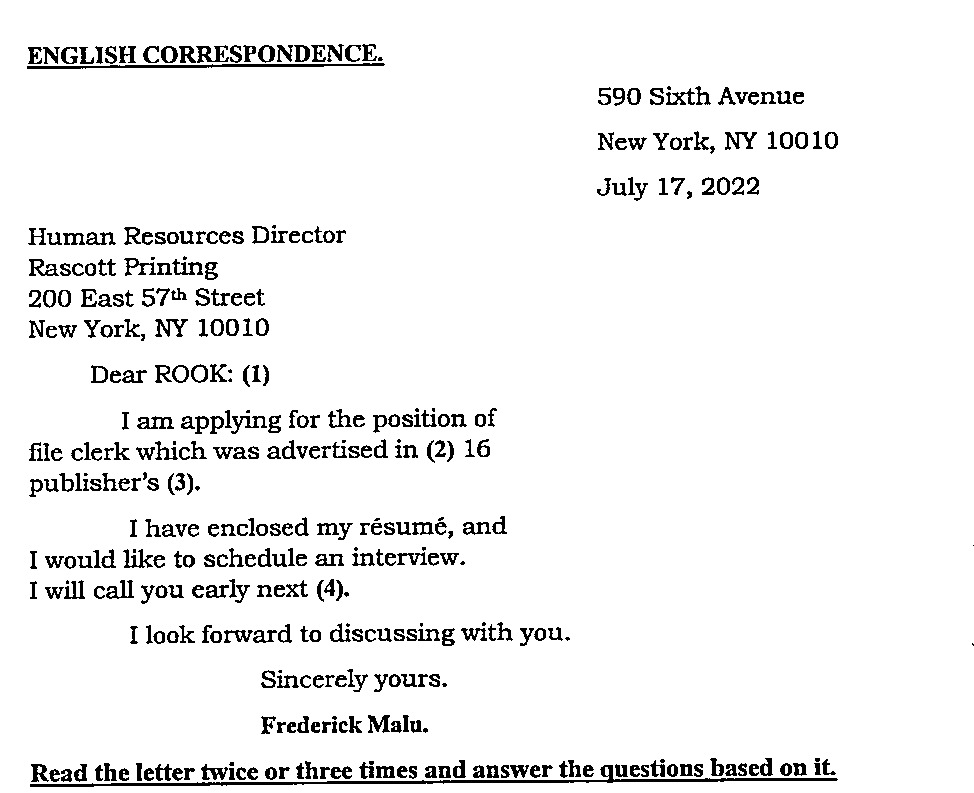
4. The appropriate word to complete the letter part numbered “2” is:
Bonne réponse : c. July
Explication détaillée :
La phrase complète dans la lettre est :
“I am applying for the position of file clerk which was advertised in (2) 16 publisher’s (3).”
Le mot manquant doit être un mois, car on parle d’une annonce publiée dans un numéro daté.
→ advertised in July 16 publisher’s …
Analyse des autres options :
My : impossible grammaticalement.
monthly : adjectif, ne peut pas compléter cette structure.
Mr : n’a aucun sens ici.
Week : ne correspond pas à la logique d’un numéro de publication.
Donc July est la seule réponse correcte.
5. (The)… contains the complete address of the writer.
The correct missing part of the letter is:
Bonne réponse : d. Letter head
Explication détaillée :
Dans une lettre commerciale, la partie qui contient l’adresse complète de l’expéditeur s’appelle :
➡️ le Letter head (l’en‑tête).
Rappel des autres parties pour bien comprendre :
Salutation : “Dear Sir…”.
Inside address : adresse du destinataire.
Signature : nom et signature de l’expéditeur.
Closing : formule de politesse finale (“Sincerely yours”).
Donc la seule partie qui contient l’adresse de l’expéditeur est Letter head.
ENGLISH TEXT
Indian and Chinese auto firms which offer low-cost models are expanding their African reach. India’s Tata motors aims to quadruple its sales in the south African market by 2018. It sold 6,500 units in 2012 but wants to bring this up to 30,000 by 2018, reaching at least 12,000 by 2014.
To achieve this, Tata plans to more than double its number of associated Moto Holdings outlets from 48 to 100 in 2018. The company has to diversify its product ranges in South Africa with new models. At the same time, the Chinese automobile firm, Foton, has become the dominant Chinese car exporter to Africa. In 2012, Foton delivered 20,000 vehicles to the region.
Although interest in Africa is rising, the current market figures are mixed. In Nigeria Africa’s most populous country, 50,000 new vehicles enter the country each year. The negative trend was attributed to sectarian violence, flooding and floundering economy. And as sales dipped to lower trends, this country claims market research to enlarge future results. The infrastructure sector grows due to investment programs.
QUESTION ON THE TEXT:
1. Insert the correct ending to this sentence.
From the text, we learn that the sale of vehicles has increased in Africa due to…………:
Bonne réponse : b. Investment programs.
Explication :
Le texte dit clairement que le secteur des infrastructures se développe grâce aux programmes d’investissement.
Or, l’augmentation des infrastructures entraîne une hausse de la demande en véhicules.
Les autres options ne sont pas mentionnées comme cause d’augmentation des ventes.
ENGLISH TEXT
Indian and Chinese auto firms which offer low-cost models are expanding their African reach. India’s Tata motors aims to quadruple its sales in the south African market by 2018. It sold 6,500 units in 2012 but wants to bring this up to 30,000 by 2018, reaching at least 12,000 by 2014.
To achieve this, Tata plans to more than double its number of associated Moto Holdings outlets from 48 to 100 in 2018. The company has to diversify its product ranges in South Africa with new models. At the same time, the Chinese automobile firm, Foton, has become the dominant Chinese car exporter to Africa. In 2012, Foton delivered 20,000 vehicles to the region.
Although interest in Africa is rising, the current market figures are mixed. In Nigeria Africa’s most populous country, 50,000 new vehicles enter the country each year. The negative trend was attributed to sectarian violence, flooding and floundering economy. And as sales dipped to lower trends, this country claims market research to enlarge future results. The infrastructure sector grows due to investment programs.
QUESTION ON THE TEXT:
2. Put in the correct phrase in this sentence.
Although Nigeria was the most crowed country in Africa, some………… reduced its demand for vehicles.
Bonne réponse : c. Social problems.
Explication :
Le texte mentionne explicitement :
sectarian violence,
flooding,
floundering economy.
Ce sont des problèmes sociaux qui ont réduit la demande de véhicules au Nigeria.
Les autres options ne correspondent pas au contenu du texte.
3. Select the right answer.
The right passive voice of the sentence “Our mother didn’t buy a new car” is:
Bonne réponse : d. A new car wasn’t bought by our mother.
Explication :
La phrase originale est au prétérit négatif actif :
→ Our mother didn’t buy a new car.
Pour la mettre à la voix passive, on transforme :
COD → sujet : a new car
didn’t buy → wasn’t bought
sujet → complément d’agent : by our mother
Donc la forme correcte est :
➡️ A new car wasn’t bought by our mother.
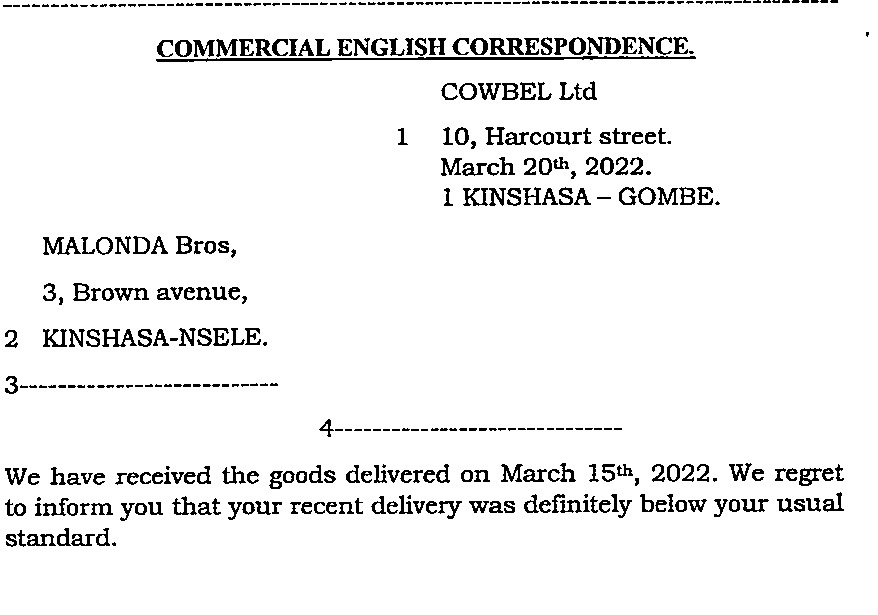
4. The appropriate word to complete the letter part numbered “2” is:
Bonne réponse : c. July
Explication détaillée :
La phrase originale est :
“I am applying for the position of file clerk which was advertised in (2) 16 publisher’s (3).”
Le mot manquant doit être un mois, car on parle d’une annonce publiée dans un numéro daté.
→ On dit : advertised in July 16 publisher’s …
Analyse des autres options :
My : impossible grammaticalement.
monthly : adjectif, ne peut pas compléter cette structure.
Mr : n’a aucun sens ici.
Week : ne correspond pas à un numéro de publication.
Donc July est la seule réponse correcte.
5. (The)… contains the complete address of the writer.
The correct missing part of the letter is:
Bonne réponse : d. Letter head
Explication détaillée :
Dans une lettre commerciale, la partie qui contient l’adresse complète de l’expéditeur s’appelle :
➡️ le Letter head (l’en‑tête).
Pour bien comprendre :
Letter head = adresse de l’expéditeur.
Inside address = adresse du destinataire.
Salutation = formule d’appel (Dear Sir…).
Closing = formule de politesse finale (Sincerely yours…).
Signature = nom et signature de l’expéditeur.
Donc la seule partie qui contient l’adresse du rédacteur de la lettre est Letter head.