
Exetat d’Anglais et Correspondance Commerciale Anglaise 2022_Commercial de Gestion
Question 1
ENGLISH TEXT
Both sides face risks in a export transaction. This is because there is always the possibility that the other side may not fulfill the contract.
For the exporters there is the risk of buyer default; the customers might not pay in full for the goods. There are several possible reasons for this: the importers might go bankrupt; a war might start or the importer's government might decide to ban imports of certain commodities. Another possibility is that the importers might run into difficulties getting the foreign exchange to pay for the goods. It is even possible that the importers are not reliable and simply refuse to pay the agreed amount of money.
For the importers there is the risk that the goods will be delayed and they might only receive them a long time after paying for them; This may be caused by port congestion or strikes. Delays in fulfillment of orders by exporters and difficult customs clearance in the importing country can cause loss of business. There is also a risk that the wrong goods might be sent.
It is to guard against such possibilities that different methods of payment have been developed.
All the countries need foreign exchange to pay for imports. Before dealing with a buyer one should always make sure they are reliable. In all business there are risks of losing money.
QUESTION ON THE TEXT:
1. The exporters and the importers face many risks in a import transaction.
This idea is contained in paragraph:
Bonne réponse : b. one
Explication :
Le premier paragraphe dit clairement :
“Both sides face risks in an export transaction.”
C’est dans le paragraphe 1 que l’idée générale des risques pour les deux parties (exportateurs et importateurs) est présentée.
Les autres paragraphes détaillent des risques spécifiques, mais l’idée globale se trouve uniquement dans le premier.
ENGLISH TEXT
Both sides face risks in a export transaction. This is because there is always the possibility that the other side may not fulfill the contract.
For the exporters there is the risk of buyer default; the customers might not pay in full for the goods. There are several possible reasons for this: the importers might go bankrupt; a war might start or the importer's government might decide to ban imports of certain commodities. Another possibility is that the importers might run into difficulties getting the foreign exchange to pay for the goods. It is even possible that the importers are not reliable and simply refuse to pay the agreed amount of money.
For the importers there is the risk that the goods will be delayed and they might only receive them a long time after paying for them; This may be caused by port congestion or strikes. Delays in fulfillment of orders by exporters and difficult customs clearance in the importing country can cause loss of business. There is also a risk that the wrong goods might be sent.
It is to guard against such possibilities that different methods of payment have been developed.
All the countries need foreign exchange to pay for imports. Before dealing with a buyer one should always make sure they are reliable. In all business there are risks of losing money.
QUESTION ON THE TEXT:
2. The word transaction means:
Bonne réponse : b. Business deal
Explication :
Le mot transaction signifie une opération commerciale, un échange d’affaires entre deux parties.
Dans le texte, il s’agit d’un export transaction, donc d’un deal commercial entre un exportateur et un importateur.
Les autres options ne correspondent pas :
Work stoppage = grève
Danger = risque
Unable to pay one’s debts = faillite
Legal written agreement = contrat
3. One of these words is correctly stressed (stressed syllable underlined):
Bonne réponse : b. exchange
Explication :
Le mot exchange se prononce :
→ ex‑CHANGE
La deuxième syllabe est accentuée, ce qui correspond à l’option donnée.
Analyse rapide des autres mots :
bankrupt → BAN‑krupt (accent sur la 1ʳᵉ syllabe)
default → de‑FAULT (accent sur la 2ᵉ syllabe, mais l’option ne montre pas l’accent correct)
reliable → re‑LI‑a‑ble (accent sur la 2ᵉ syllabe)
possibility → pos‑si‑BI‑li‑ty (accent sur la 3ᵉ syllabe)
La seule option correctement soulignée est exchange.
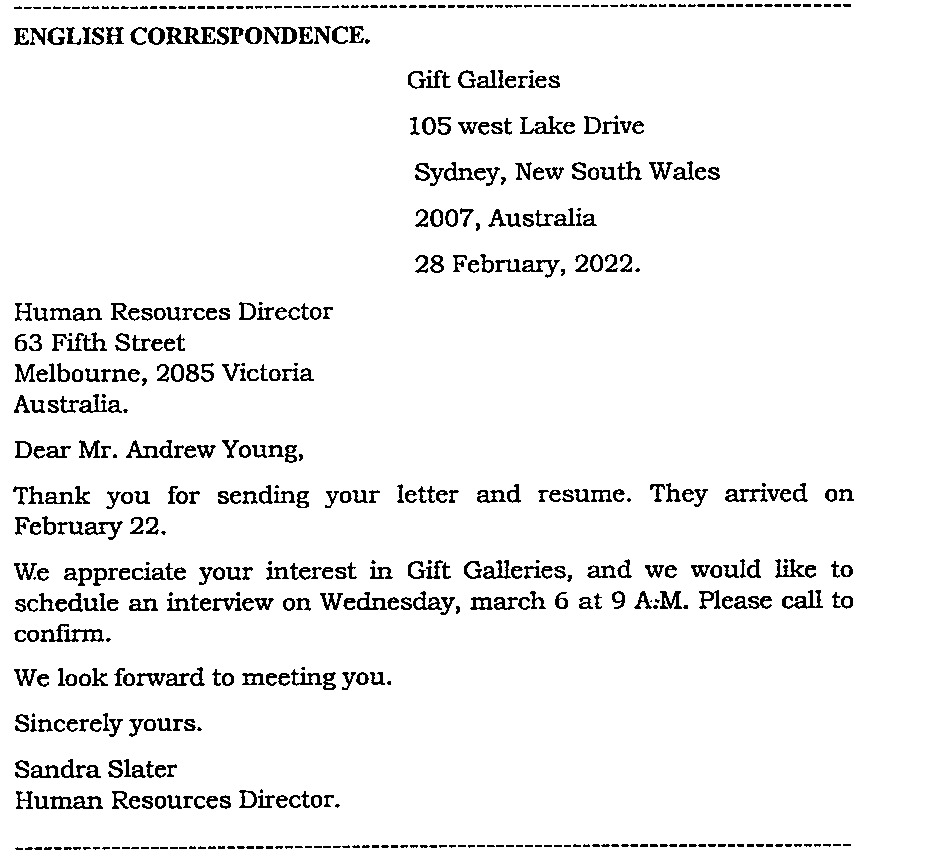
4. The above letter is:
Bonne réponse : e. A reply to an applicant.
Explication détaillée :
La lettre présentée :
remercie le candidat pour sa lettre et son CV,
confirme la réception de sa candidature,
l’invite à un entretien,
demande une confirmation de sa part.
Ce type de lettre n’est pas :
une plainte (complaint),
un rappel (reminder),
un e-mail,
une lettre de candidature (application letter).
Elle constitue clairement une réponse adressée à un candidat → a reply to an applicant.
5. We use a (an) ... to introduce a list.
The missing word to complete the above statement is:
Bonne réponse : a. Colon
Explication détaillée :
En anglais, pour introduire une liste, on utilise :
➡️ le colon ( : )
Exemples :
You need the following items: a pen, a notebook, and a ruler.
The company requires: honesty, punctuality, and teamwork.
Les autres signes ne conviennent pas :
hyphen (-) : relie des mots.
comma (,) : sépare des éléments mais n’introduit pas une liste.
semi-colon (;) : sépare des groupes complexes.
apostrophe (’) : indique possession ou contraction.
Donc la seule réponse correcte est colon.
ENGLISH TEXT
Both sides face risks in a export transaction. This is because there is always the possibility that the other side may not fulfill the contract.
For the exporters there is the risk of buyer default; the customers might not pay in full for the goods. There are several possible reasons for this: the importers might go bankrupt; a war might start or the importer's government might decide to ban imports of certain commodities. Another possibility is that the importers might run into difficulties getting the foreign exchange to pay for the goods. It is even possible that the importers are not reliable and simply refuse to pay the agreed amount of money.
For the importers there is the risk that the goods will be delayed and they might only receive them a long time after paying for them; This may be caused by port congestion or strikes. Delays in fulfillment of orders by exporters and difficult customs clearance in the importing country can cause loss of business. There is also a risk that the wrong goods might be sent.
It is to guard against such possibilities that different methods of payment have been developed.
All the countries need foreign exchange to pay for imports. Before dealing with a buyer one should always make sure they are reliable. In all business there are risks of losing money.
QUESTION ON THE TEXT:
1. Loss of business can be caused by delays in fulfillment of orders by exporters and difficult customs clearance in the importing country.
This idea is contained in paragraph:
Bonne réponse : c. three
Explication :
Le troisième paragraphe dit clairement :
“Delays in fulfillment of orders by exporters and difficult customs clearance in the importing country can cause loss of business.”
C’est exactement l’idée exprimée dans la question.
Donc la réponse correcte est le paragraphe 3.
ENGLISH TEXT
Both sides face risks in a export transaction. This is because there is always the possibility that the other side may not fulfill the contract.
For the exporters there is the risk of buyer default; the customers might not pay in full for the goods. There are several possible reasons for this: the importers might go bankrupt; a war might start or the importer's government might decide to ban imports of certain commodities. Another possibility is that the importers might run into difficulties getting the foreign exchange to pay for the goods. It is even possible that the importers are not reliable and simply refuse to pay the agreed amount of money.
For the importers there is the risk that the goods will be delayed and they might only receive them a long time after paying for them; This may be caused by port congestion or strikes. Delays in fulfillment of orders by exporters and difficult customs clearance in the importing country can cause loss of business. There is also a risk that the wrong goods might be sent.
It is to guard against such possibilities that different methods of payment have been developed.
All the countries need foreign exchange to pay for imports. Before dealing with a buyer one should always make sure they are reliable. In all business there are risks of losing money.
QUESTION ON THE TEXT:
2. The word risk means:
Bonne réponse : c. Danger
Explication :
Le mot risk signifie danger, possibilité de perte, menace potentielle.
Dans le texte, il s’agit des dangers auxquels font face exportateurs et importateurs.
Les autres options ne correspondent pas :
Work stoppage = grève
Business deal = transaction
Unable to pay one’s debts = faillite
Legal written agreement = contrat
3. One of these words is correctly stressed (stressed syllable underlined):
Bonne réponse : b. exchange
Explication :
Le mot exchange se prononce :
→ ex‑CHANGE
La syllabe accentuée est la deuxième, ce qui correspond à l’option donnée.
Analyse rapide des autres mots :
bankrupt → BAN‑krupt (accent sur la 1ʳᵉ syllabe)
default → de‑FAULT (accent sur la 2ᵉ syllabe, mais l’option ne montre pas l’accent correct)
reliable → re‑LI‑a‑ble (accent sur la 2ᵉ syllabe)
possibility → pos‑si‑BI‑li‑ty (accent sur la 3ᵉ syllabe)
La seule option correctement soulignée est exchange.
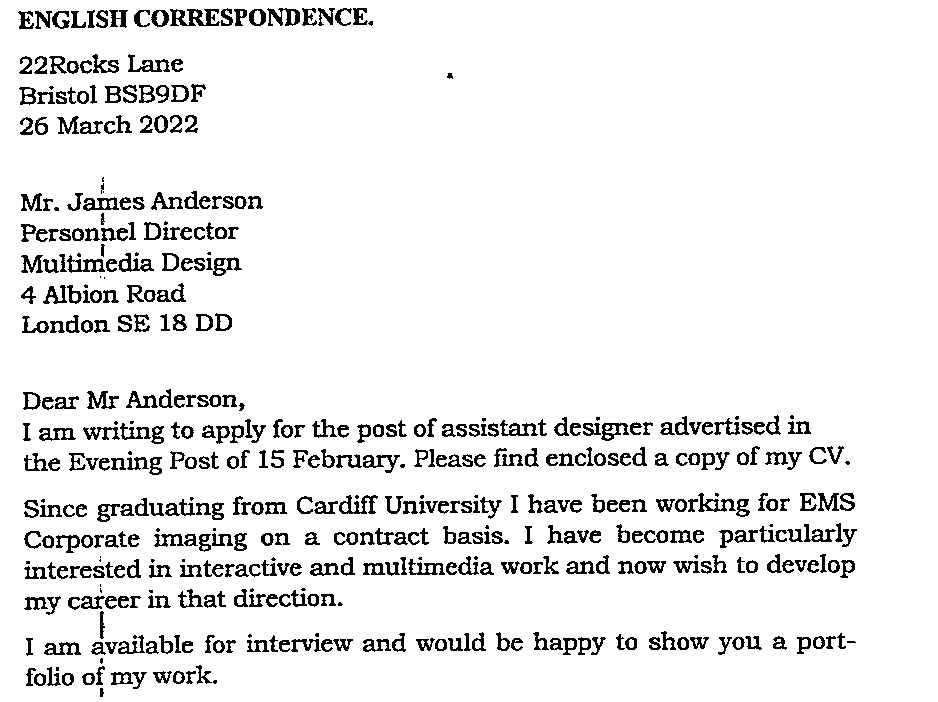
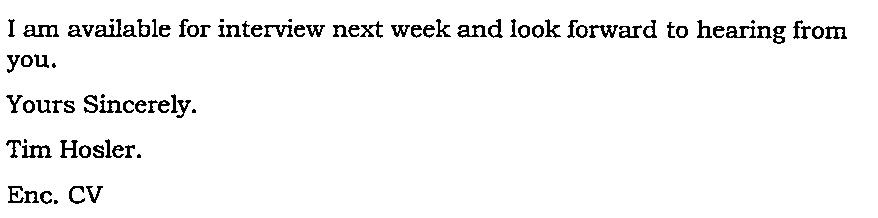
4. The above letter is:
Bonne réponse : d. An application letter.
Explication détaillée :
La lettre présentée contient :
l’adresse de l’expéditeur,
la date,
l’adresse du destinataire,
une formule d’appel,
une présentation du poste visé,
l’expérience du candidat,
la disponibilité pour un entretien,
une formule de politesse et une signature.
Ce sont toutes les caractéristiques d’une lettre de candidature (application letter).
Les autres options ne conviennent pas :
complaint letter : exprime une plainte → ce n’est pas le cas.
reminder letter : sert à rappeler une obligation → non.
e-mail : ce n’est pas un e-mail mais une lettre formelle.
reply to applicant : ce serait une réponse à un candidat → ici, c’est le candidat qui écrit.
5. We use (an) … in certain fixed expressions.
The missing word to complete the above statement is:
Bonne réponse : e. apostrophe
Explication détaillée :
L’énoncé dit :
→ We use (an) … in certain fixed expressions.
En anglais, l’apostrophe est utilisée dans plusieurs expressions figées, notamment :
O’clock
Today’s meeting
At arm’s length
Elle sert aussi pour :
les contractions (don’t, I’m, can’t),
la possession (John’s book).
Les autres signes ne sont pas utilisés dans des expressions figées :
colon : introduit une liste.
hyphen : relie des mots.
comma : sépare des éléments.
semi-colon : sépare deux propositions indépendantes.
Donc la seule réponse correcte est apostrophe.
ENGLISH TEXT
Both sides face risks in a export transaction. This is because there is always the possibility that the other side may not fulfill the contract.
For the exporters there is the risk of buyer default; the customers might not pay in full for the goods. There are several possible reasons for this: the importers might go bankrupt; a war might start or the importer's government might decide to ban imports of certain commodities. Another possibility is that the importers might run into difficulties getting the foreign exchange to pay for the goods. It is even possible that the importers are not reliable and simply refuse to pay the agreed amount of money.
For the importers there is the risk that the goods will be delayed and they might only receive them a long time after paying for them; This may be caused by port congestion or strikes. Delays in fulfillment of orders by exporters and difficult customs clearance in the importing country can cause loss of business. There is also a risk that the wrong goods might be sent.
It is to guard against such possibilities that different methods of payment have been developed.
All the countries need foreign exchange to pay for imports. Before dealing with a buyer one should always make sure they are reliable. In all business there are risks of losing money.
QUESTION ON THE TEXT:
1. Different methods of payment have been developed to avoid the risk that wrong goods might be sent.
Bonne réponse : d. five
Explication :
L’idée selon laquelle des méthodes de paiement ont été développées pour éviter le risque que de mauvais produits soient envoyés apparaît dans le cinquième paragraphe, qui commence par :
“It is to guard against such possibilities that different methods of payment have been developed.”
Donc la réponse correcte est paragraphe 5.
ENGLISH TEXT
Both sides face risks in a export transaction. This is because there is always the possibility that the other side may not fulfill the contract.
For the exporters there is the risk of buyer default; the customers might not pay in full for the goods. There are several possible reasons for this: the importers might go bankrupt; a war might start or the importer's government might decide to ban imports of certain commodities. Another possibility is that the importers might run into difficulties getting the foreign exchange to pay for the goods. It is even possible that the importers are not reliable and simply refuse to pay the agreed amount of money.
For the importers there is the risk that the goods will be delayed and they might only receive them a long time after paying for them; This may be caused by port congestion or strikes. Delays in fulfillment of orders by exporters and difficult customs clearance in the importing country can cause loss of business. There is also a risk that the wrong goods might be sent.
It is to guard against such possibilities that different methods of payment have been developed.
All the countries need foreign exchange to pay for imports. Before dealing with a buyer one should always make sure they are reliable. In all business there are risks of losing money.
QUESTION ON THE TEXT:
2. The word bankrupt means:
Bonne réponse : d. Unable to pay one’s debts.
Explication :
Le mot bankrupt signifie :
➡️ incapable de payer ses dettes, en faillite.
Dans le texte, on lit :
“the importers might go bankrupt”
Ce qui confirme que bankrupt = unable to pay one’s debts.
Les autres options ne correspondent pas :
work stoppage = grève
business deal = transaction
danger = risk
legal written agreement = contract
3. One of these words is correctly stressed (stressed syllable underlined):
Bonne réponse : b. exCHANGE
Explication :
Le mot exchange se prononce :
→ ex‑CHANGE
La syllabe accentuée est la deuxième, ce qui correspond exactement à l’option proposée.
Analyse rapide des autres mots :
bankrupt → BAN‑krupt (accent sur la 1ʳᵉ syllabe)
default → de‑FAULT (accent sur la 2ᵉ syllabe, mais l’option ne montre pas l’accent correct)
reliable → re‑LI‑a‑ble (accent sur la 2ᵉ syllabe)
possibility → pos‑si‑BI‑li‑ty (accent sur la 3ᵉ syllabe)
La seule option correctement soulignée est exchange.
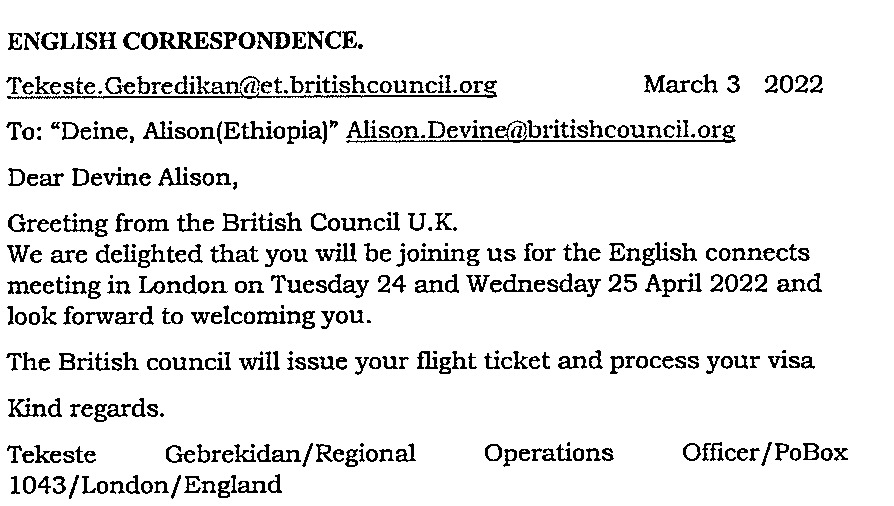
4. The above letter is:
Bonne réponse : c. An e-mail
Explication :
Le document présenté est un message électronique :
il contient une adresse e-mail (tekeste.gebrekidan@et.britishcouncil.org),
il est rédigé sous forme de courriel professionnel,
il n’a pas la structure d’une lettre imprimée classique.
Ce n’est donc ni :
une plainte,
un rappel,
une lettre de candidature,
une réponse à un candidat.
La seule réponse correcte est c. An e-mail.
5. We use (an) … to indicate omissions in contractions.
Bonne réponse : e. apostrophe
ENGLISH TEXT
Both sides face risks in a export transaction. This is because there is always the possibility that the other side may not fulfill the contract.
For the exporters there is the risk of buyer default; the customers might not pay in full for the goods. There are several possible reasons for this: the importers might go bankrupt; a war might start or the importer's government might decide to ban imports of certain commodities. Another possibility is that the importers might run into difficulties getting the foreign exchange to pay for the goods. It is even possible that the importers are not reliable and simply refuse to pay the agreed amount of money.
For the importers there is the risk that the goods will be delayed and they might only receive them a long time after paying for them; This may be caused by port congestion or strikes. Delays in fulfillment of orders by exporters and difficult customs clearance in the importing country can cause loss of business. There is also a risk that the wrong goods might be sent.
It is to guard against such possibilities that different methods of payment have been developed.
All the countries need foreign exchange to pay for imports. Before dealing with a buyer one should always make sure they are reliable. In all business there are risks of losing money.
QUESTION ON THE TEXT:
1. The exporters run the risk of buyer default when the customers might not pay in full for goods.
This idea is contained in paragraph:
Bonne réponse : e. two
Explication :
Le deuxième paragraphe explique clairement :
“For the exporters there is the risk of buyer default; the customers might not pay in full for the goods.”
C’est exactement l’idée exprimée dans la question.
Donc la réponse correcte est le paragraphe 2.
ENGLISH TEXT
Both sides face risks in a export transaction. This is because there is always the possibility that the other side may not fulfill the contract.
For the exporters there is the risk of buyer default; the customers might not pay in full for the goods. There are several possible reasons for this: the importers might go bankrupt; a war might start or the importer's government might decide to ban imports of certain commodities. Another possibility is that the importers might run into difficulties getting the foreign exchange to pay for the goods. It is even possible that the importers are not reliable and simply refuse to pay the agreed amount of money.
For the importers there is the risk that the goods will be delayed and they might only receive them a long time after paying for them; This may be caused by port congestion or strikes. Delays in fulfillment of orders by exporters and difficult customs clearance in the importing country can cause loss of business. There is also a risk that the wrong goods might be sent.
It is to guard against such possibilities that different methods of payment have been developed.
All the countries need foreign exchange to pay for imports. Before dealing with a buyer one should always make sure they are reliable. In all business there are risks of losing money.
QUESTION ON THE TEXT:
2. The word “strike” means:
Bonne réponse : a. Work stoppage.
Explication :
Le mot strike signifie grève, c’est‑à‑dire un arrêt de travail.
Dans le texte, les grèves sont mentionnées comme une cause de retard dans la livraison des marchandises.
Les autres options ne correspondent pas :
business deal = transaction
danger = risk
unable to pay one’s debts = bankrupt
legal written agreement = contract
3. One of these words is correctly stressed (stressed syllable underlined):
Bonne réponse : b. exchange
Explication :
Le mot exchange se prononce :
→ ex‑CHANGE
La syllabe accentuée est la deuxième, ce qui correspond exactement à l’option proposée.
Analyse rapide des autres mots :
bankrupt → BAN‑krupt (accent sur la 1ʳᵉ syllabe)
default → de‑FAULT (accent sur la 2ᵉ syllabe, mais l’option ne montre pas l’accent correct)
reliable → re‑LI‑a‑ble (accent sur la 2ᵉ syllabe)
possibility → pos‑si‑BI‑li‑ty (accent sur la 3ᵉ syllabe)
La seule option correctement soulignée est exchange.
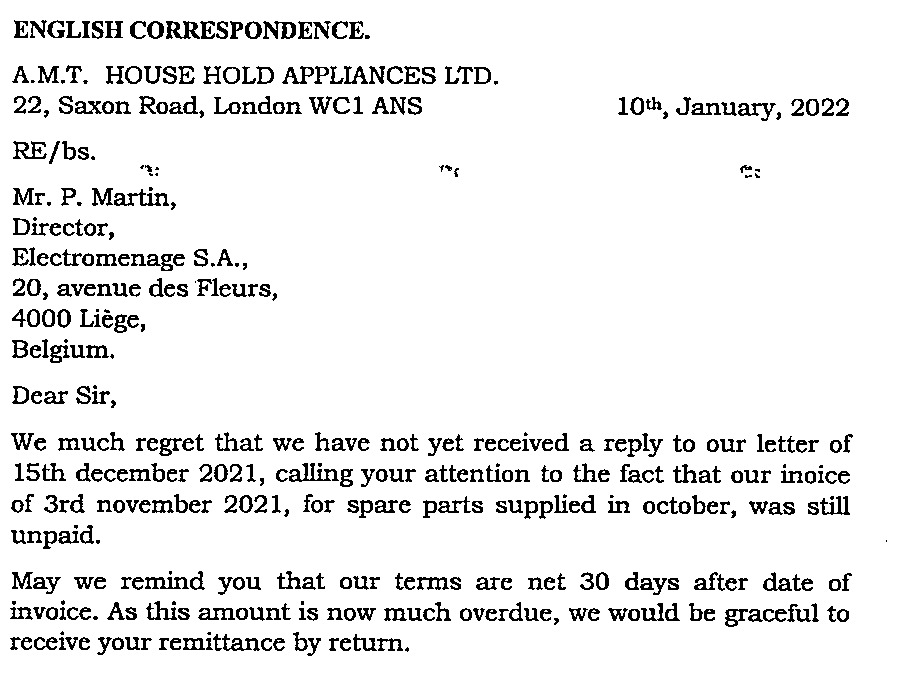
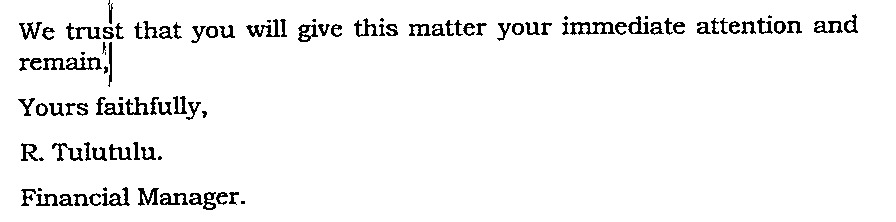
4. The above letter is:
Bonne réponse : b. A reminder letter.
Explication :
La lettre dit clairement :
qu’ils n’ont pas encore reçu de réponse à leur lettre précédente,
qu’ils rappellent une facture impayée,
qu’ils demandent une remise immédiate du paiement.
Ce type de courrier est typique d’une lettre de rappel (reminder letter), envoyée lorsqu’un client n’a pas payé dans les délais.
Les autres options ne conviennent pas :
complaint letter : exprime une plainte → ce n’est pas le cas.
e-mail : ce n’est pas un e-mail mais une lettre commerciale formelle.
application letter : lettre de candidature → non.
reply to an applicant : réponse à un candidat → non.
5. We use a (an) ... to separate elements in addresses.
The missing word to complete the above statement is:
Bonne réponse : c. comma
Explication :
Dans les adresses anglaises, on utilise la virgule (comma) pour séparer les éléments :
Exemples :
22, Saxon Road, London WC1 ANS
20, avenue des Fleurs, 4000 Liège, Belgium
La virgule sert à séparer :
le numéro et la rue,
la rue et la ville,
la ville et le pays.
Les autres signes ne conviennent pas :
colon → introduit une liste
hyphen → relie des mots
semi-colon → sépare deux propositions
apostrophe → possession ou contraction
La seule réponse correcte est donc comma.