Exetat d’Anglais et Correspondance Commerciale Anglaise 2016_Commercial de Gestion
Question 1
TEXT
John Martin is due back from his trip to Africa today and there is also a pile of work on his desk. Unfortunately, there is also an unpleasant surprise waiting for him. His very efficient secretary, Sally, has just telephoned to say that she is ill and cannot come into the office today. Elisabeth, Mr. Bill's secretary copes with the emergency by going to see the chief clerk in the General office and asking him if he will lend Mr. Martin one of his short land-typists while, Sally is away.
The general office is a very busy place. It handles, among other things, all the office printing and duplicating. It also deals with the mail: the staff open all the letters in the morning and send them round to the appropriate offices. Twice daily they collect all the outgoing letters Franck them and post them. They also have an addressing machine, which prints addresses on envelopes, folds the letters and seals the envelopes very rapidly. This is used for advertising and publicity, as well as addressing all order acknowledgements, delivery notes and monthly statements of account. The chief clerk, Mr. Baker, reluctantly agrees to lend Fenella, who is inexperienced but willing. Elisabeth tells her where to find the stationery, gives her a few helpful hints and then leaves her to her fate.
Mr. Martin has a much bigger emergency to cope with as soon as he arrives. Thirty desks have failed to arrive in Holland, and the agent there, Mr. Van, rings Mr. Martin in a panic because he is responsible for seeing that they are delivered by a certain date to the Dutch customers. The firm use forwarding agents to clear the goods through customs, transport them and deliver them. But something has gone wrong somewhere along the line.
Apart from this, and many other jobs which need his attention, John has also got to report to Mr. Christopher on his trip to Africa.
They discuss the chances of opening up a new market there, who they will use as an agent and how the money to pay for the goods will be transferred to Britain. Mr. Christopher decides he wants an irrevocable letter of credit. A letter of credit is sent by a bank to an exporter informing him that payment for goods is at the bank.
QUESTION BASED ON THE TEXT: 1. “Imagine that you are a big boss and you run business. Your company will be certainly organized in different departments. The one who wants to sell anything will address his letter to the….. Department”. The missing word(s) in the sentence is (are):
Bonne réponse : e. sales
Explication :
Le département qui s’occupe de vendre les produits est le Sales Department.
Les autres départements (finance, personnel, buying, market research) ont d’autres fonctions, mais sales est celui qui gère les ventes et les clients.
TEXT
John Martin is due back from his trip to Africa today and there is also a pile of work on his desk. Unfortunately, there is also an unpleasant surprise waiting for him. His very efficient secretary, Sally, has just telephoned to say that she is ill and cannot come into the office today. Elisabeth, Mr. Bill's secretary copes with the emergency by going to see the chief clerk in the General office and asking him if he will lend Mr. Martin one of his short land-typists while, Sally is away.
The general office is a very busy place. It handles, among other things, all the office printing and duplicating. It also deals with the mail: the staff open all the letters in the morning and send them round to the appropriate offices. Twice daily they collect all the outgoing letters Franck them and post them. They also have an addressing machine, which prints addresses on envelopes, folds the letters and seals the envelopes very rapidly. This is used for advertising and publicity, as well as addressing all order acknowledgements, delivery notes and monthly statements of account. The chief clerk, Mr. Baker, reluctantly agrees to lend Fenella, who is inexperienced but willing. Elisabeth tells her where to find the stationery, gives her a few helpful hints and then leaves her to her fate.
Mr. Martin has a much bigger emergency to cope with as soon as he arrives. Thirty desks have failed to arrive in Holland, and the agent there, Mr. Van, rings Mr. Martin in a panic because he is responsible for seeing that they are delivered by a certain date to the Dutch customers. The firm use forwarding agents to clear the goods through customs, transport them and deliver them. But something has gone wrong somewhere along the line.
Apart from this, and many other jobs which need his attention, John has also got to report to Mr. Christopher on his trip to Africa.
They discuss the chances of opening up a new market there, who they will use as an agent and how the money to pay for the goods will be transferred to Britain. Mr. Christopher decides he wants an irrevocable letter of credit. A letter of credit is sent by a bank to an exporter informing him that payment for goods is at the bank.
QUESTION BASED ON THE TEXT: 2. Indicate the association (III) which correctly matches the words (I) with their meanings (II).
a. A person who buys goods b. A person who controls a business c. A person who provides goods d. A notice to make something known e. A group of people working together
Bonne réponse : 2. 1d, 2a, 3b, 4e, 5c
Explication :
Advertisement → d. A notice to make something known
Customer → a. A person who buys goods
Manager → b. A person who controls a business
Staff → e. A group of people working together
Supplier → c. A person who provides goods
La combinaison 2 est la seule correcte.
TEXT
John Martin is due back from his trip to Africa today and there is also a pile of work on his desk. Unfortunately, there is also an unpleasant surprise waiting for him. His very efficient secretary, Sally, has just telephoned to say that she is ill and cannot come into the office today. Elisabeth, Mr. Bill's secretary copes with the emergency by going to see the chief clerk in the General office and asking him if he will lend Mr. Martin one of his short land-typists while, Sally is away.
The general office is a very busy place. It handles, among other things, all the office printing and duplicating. It also deals with the mail: the staff open all the letters in the morning and send them round to the appropriate offices. Twice daily they collect all the outgoing letters Franck them and post them. They also have an addressing machine, which prints addresses on envelopes, folds the letters and seals the envelopes very rapidly. This is used for advertising and publicity, as well as addressing all order acknowledgements, delivery notes and monthly statements of account. The chief clerk, Mr. Baker, reluctantly agrees to lend Fenella, who is inexperienced but willing. Elisabeth tells her where to find the stationery, gives her a few helpful hints and then leaves her to her fate.
Mr. Martin has a much bigger emergency to cope with as soon as he arrives. Thirty desks have failed to arrive in Holland, and the agent there, Mr. Van, rings Mr. Martin in a panic because he is responsible for seeing that they are delivered by a certain date to the Dutch customers. The firm use forwarding agents to clear the goods through customs, transport them and deliver them. But something has gone wrong somewhere along the line.
Apart from this, and many other jobs which need his attention, John has also got to report to Mr. Christopher on his trip to Africa.
They discuss the chances of opening up a new market there, who they will use as an agent and how the money to pay for the goods will be transferred to Britain. Mr. Christopher decides he wants an irrevocable letter of credit. A letter of credit is sent by a bank to an exporter informing him that payment for goods is at the bank.
QUESTION BASED ON THE TEXT: 3. The General Office deals with:
Bonne réponse : a. Printing and duplicating
Explication :
Le texte précise que le General Office s’occupe :
➡️ “of all the office printing and duplicating”
ainsi que du courrier et des documents administratifs.
Donc la bonne réponse est printing and duplicating.
TEXT
John Martin is due back from his trip to Africa today and there is also a pile of work on his desk. Unfortunately, there is also an unpleasant surprise waiting for him. His very efficient secretary, Sally, has just telephoned to say that she is ill and cannot come into the office today. Elisabeth, Mr. Bill's secretary copes with the emergency by going to see the chief clerk in the General office and asking him if he will lend Mr. Martin one of his short land-typists while, Sally is away.
The general office is a very busy place. It handles, among other things, all the office printing and duplicating. It also deals with the mail: the staff open all the letters in the morning and send them round to the appropriate offices. Twice daily they collect all the outgoing letters Franck them and post them. They also have an addressing machine, which prints addresses on envelopes, folds the letters and seals the envelopes very rapidly. This is used for advertising and publicity, as well as addressing all order acknowledgements, delivery notes and monthly statements of account. The chief clerk, Mr. Baker, reluctantly agrees to lend Fenella, who is inexperienced but willing. Elisabeth tells her where to find the stationery, gives her a few helpful hints and then leaves her to her fate.
Mr. Martin has a much bigger emergency to cope with as soon as he arrives. Thirty desks have failed to arrive in Holland, and the agent there, Mr. Van, rings Mr. Martin in a panic because he is responsible for seeing that they are delivered by a certain date to the Dutch customers. The firm use forwarding agents to clear the goods through customs, transport them and deliver them. But something has gone wrong somewhere along the line.
Apart from this, and many other jobs which need his attention, John has also got to report to Mr. Christopher on his trip to Africa.
They discuss the chances of opening up a new market there, who they will use as an agent and how the money to pay for the goods will be transferred to Britain. Mr. Christopher decides he wants an irrevocable letter of credit. A letter of credit is sent by a bank to an exporter informing him that payment for goods is at the bank.
QUESTION BASED ON THE TEXT: 4. The letter of credit is sent by:
Bonne réponse : b. A bank
Explication :
Le texte dit :
➡️ “A letter of credit is sent by a bank to an exporter informing him that payment for goods is at the bank.”
C’est donc la banque qui envoie la lettre de crédit pour garantir le paiement.
5. Tick the usual numbered position: Doesn’t (1) work (2) my son (3) at school (4) hard (5) in September (6).
Bonne réponse : a. 312456
Explication :
On doit remettre les groupes dans l’ordre normal d’une phrase anglaise.
La phrase correcte est :
➡️ My son doesn’t work hard at school in September.
Ordre logique :
3 (my son)
1 (doesn’t)
2 (work)
4 (at school)
5 (hard)
6 (in September)
Ce qui donne : 312456.
6. “The baby … Mother is always out is weeping”. The word(s) to complete this sentence is (are):
Bonne réponse : e. whose
Explication :
La phrase correcte est :
➡️ “The baby whose mother is always out is weeping.”
whose exprime la possession → la mère du bébé.
Les autres options ne conviennent pas :
that / who / whom → sujets ou objets, pas possession
to whom → complément indirect, impossible ici
Donc seul whose donne une phrase correcte et naturelle.
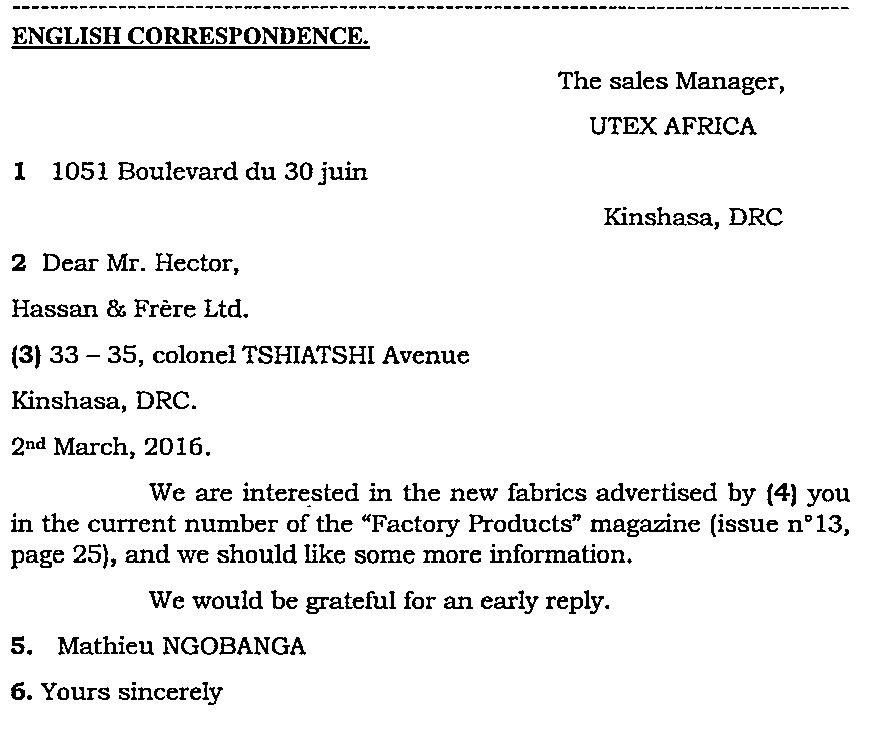
7. This letter is:
Bonne réponse : b. an enquiry
Explication :
La lettre dit :
➡️ “we should like some more information.”
Demander des informations = enquiry.
Ce n’est ni une plainte, ni une commande, ni une offre.
8. The correct order of this letter is:
Bonne réponse : d. 1,3,2,4,5,6
Explication :
L’ordre correct d’une lettre commerciale est :
1 → Adresse de l’expéditeur
3 → Adresse du destinataire
2 → Salutation
4 → Corps de la lettre
5 → Signature (nom)
6 → Complimentary close
La seule combinaison respectant cette structure est 1,3,2,4,5,6.
9. The part numbered “6” is the:
Bonne réponse : a. Complimentary close
Explication :
Le numéro 6 correspond à :
➡️ “Yours sincerely”
C’est la complimentary close, c’est‑à‑dire la formule de politesse finale.
Ce n’est pas la signature (5), ni l’adresse, ni la salutation.