Exetat d’Anglais et Correspondance Commerciale Anglaise 2017_Commercial de Gestion
Question 1
TEXT
After World War II, the number of restaurants specializing in fast food grew tremendously, and each needed a special feature to survive in the competitive market place.
No matter where fast food restaurants are located what type of food they sell, their most fundamental operating principle standardization. A hamburger from New York must taste the same as the one prepared in London, or in Kinshasa or Lubumbashi. To succeed with this formula of selling the exact same food everywhere, fast food industries must offer a standardizes menu that limits the number of goods choices.
Slogans such as " We love to see you smile ", " What you want is what you get " have been used as advertisements by fast food companies over the years. With commercials featuring cheerful music and catchy jingles broadcast on radio and television, they rely on sophisticated marketing to convince consumers that their product offers the best taste and value, or is the most fun to eat. Much of the marketing of fast food is specifically targeted to children. They frequently offer a free toy with every purchase and in so doing, the children will persuade their parents to take them there. To attract adults, fast food marketing campaign emphasize the method of food preparation rather than fun. Typical promotions are " Two for the price of one " or " Buy one at the regular price and get a second on free "!
There have been innumerable contest at fast food companies with the expectation that customers will feel hungry as well as lucky. Prizes can range from a free productor drink to an all - expenses - paid vacation. Whether by gimmicks or giveaways, marketing in the fast food industry is crucial because it helps firms distinguish themselves from competitors that offer almost exactly the same type of produce.
QUESTION BASED ON THE TEXT: 1. The title which suits the whole text is:
Bonne réponse : c. World fast food
Explication :
Le texte parle :
de l’histoire du fast‑food après la Seconde Guerre mondiale,
de la standardisation mondiale,
de la publicité,
du marketing ciblant enfants et adultes.
Le titre qui couvre tout le contenu est World fast food.
Les autres titres sont trop limités ou ne couvrent qu’une partie du texte.
TEXT
After World War II, the number of restaurants specializing in fast food grew tremendously, and each needed a special feature to survive in the competitive market place.
No matter where fast food restaurants are located what type of food they sell, their most fundamental operating principle standardization. A hamburger from New York must taste the same as the one prepared in London, or in Kinshasa or Lubumbashi. To succeed with this formula of selling the exact same food everywhere, fast food industries must offer a standardizes menu that limits the number of goods choices.
Slogans such as " We love to see you smile ", " What you want is what you get " have been used as advertisements by fast food companies over the years. With commercials featuring cheerful music and catchy jingles broadcast on radio and television, they rely on sophisticated marketing to convince consumers that their product offers the best taste and value, or is the most fun to eat. Much of the marketing of fast food is specifically targeted to children. They frequently offer a free toy with every purchase and in so doing, the children will persuade their parents to take them there. To attract adults, fast food marketing campaign emphasize the method of food preparation rather than fun. Typical promotions are " Two for the price of one " or " Buy one at the regular price and get a second on free "!
There have been innumerable contest at fast food companies with the expectation that customers will feel hungry as well as lucky. Prizes can range from a free productor drink to an all - expenses - paid vacation. Whether by gimmicks or giveaways, marketing in the fast food industry is crucial because it helps firms distinguish themselves from competitors that offer almost exactly the same type of produce.
QUESTION BASED ON THE TEXT: 2. The word “they” underlined in paragraph two refers to:
Bonne réponse : c. companies
Explication :
Dans le paragraphe 2, “they” renvoie à :
➡️ fast food companies
qui utilisent des slogans, des jingles, des publicités, etc.
Ce ne sont pas les enfants, ni les restaurants en général, ni les concurrents.
Le mot le plus précis est companies.
TEXT
After World War II, the number of restaurants specializing in fast food grew tremendously, and each needed a special feature to survive in the competitive market place.
No matter where fast food restaurants are located what type of food they sell, their most fundamental operating principle standardization. A hamburger from New York must taste the same as the one prepared in London, or in Kinshasa or Lubumbashi. To succeed with this formula of selling the exact same food everywhere, fast food industries must offer a standardizes menu that limits the number of goods choices.
Slogans such as " We love to see you smile ", " What you want is what you get " have been used as advertisements by fast food companies over the years. With commercials featuring cheerful music and catchy jingles broadcast on radio and television, they rely on sophisticated marketing to convince consumers that their product offers the best taste and value, or is the most fun to eat. Much of the marketing of fast food is specifically targeted to children. They frequently offer a free toy with every purchase and in so doing, the children will persuade their parents to take them there. To attract adults, fast food marketing campaign emphasize the method of food preparation rather than fun. Typical promotions are " Two for the price of one " or " Buy one at the regular price and get a second on free "!
There have been innumerable contest at fast food companies with the expectation that customers will feel hungry as well as lucky. Prizes can range from a free productor drink to an all - expenses - paid vacation. Whether by gimmicks or giveaways, marketing in the fast food industry is crucial because it helps firms distinguish themselves from competitors that offer almost exactly the same type of produce.
QUESTION BASED ON THE TEXT: 3. To attract adults, fast food marketing campaigns should focus a lens on:
Bonne réponse : b. food value
Explication :
Le texte dit :
➡️ “To attract adults, fast food marketing campaigns emphasize the method of food preparation rather than fun.”
Les adultes sont sensibles :
à la qualité,
à la valeur nutritive,
à la préparation.
Donc la bonne réponse est food value.
Les autres options ciblent les enfants (musique, jouets, slogans amusants).
TEXT
After World War II, the number of restaurants specializing in fast food grew tremendously, and each needed a special feature to survive in the competitive market place.
No matter where fast food restaurants are located what type of food they sell, their most fundamental operating principle standardization. A hamburger from New York must taste the same as the one prepared in London, or in Kinshasa or Lubumbashi. To succeed with this formula of selling the exact same food everywhere, fast food industries must offer a standardizes menu that limits the number of goods choices.
Slogans such as " We love to see you smile ", " What you want is what you get " have been used as advertisements by fast food companies over the years. With commercials featuring cheerful music and catchy jingles broadcast on radio and television, they rely on sophisticated marketing to convince consumers that their product offers the best taste and value, or is the most fun to eat. Much of the marketing of fast food is specifically targeted to children. They frequently offer a free toy with every purchase and in so doing, the children will persuade their parents to take them there. To attract adults, fast food marketing campaign emphasize the method of food preparation rather than fun. Typical promotions are " Two for the price of one " or " Buy one at the regular price and get a second on free "!
There have been innumerable contest at fast food companies with the expectation that customers will feel hungry as well as lucky. Prizes can range from a free productor drink to an all - expenses - paid vacation. Whether by gimmicks or giveaways, marketing in the fast food industry is crucial because it helps firms distinguish themselves from competitors that offer almost exactly the same type of produce.
QUESTION BASED ON THE TEXT: 4. The term “menu” (l.9) refers to the:
Bonne réponse : a. List of good dishes to be served at a meal
Explication :
Le mot menu signifie :
➡️ la liste des plats proposés.
Dans le texte, le menu est standardisé pour garantir le même goût partout.
Les autres options ne correspondent pas du tout au sens du mot.
5. Indicate the combination which associates correctly items (I) with those in (II) to get pair of words with similar meaning.
(I)
1. Revenue 2. Advertising 3. Wholesaler 4. Research Target
(II)
a. retailer b. objective c. earnings d. promotion e. innovation
Bonne réponse : 4. 1c, 2d, 3a, 4e, 5b
Explication :
On doit associer chaque mot avec son synonyme ou un terme de sens proche :
Advertising → promotion (d)
Advertising = action de promouvoir un produit.
Wholesaler → retailer (a)
Wholesaler = grossiste ; retailer = détaillant → ce sont des acteurs du commerce opposés mais associés dans la chaîne commerciale.
Research → innovation (e)
La recherche mène à l’innovation.
Target → objective (b)
Target = objectif visé.
La combinaison 4 est la seule qui correspond exactement.
6. Tickets not used within the availability are null and void, …..?
Bonne réponse : e. aren’t they
Explication :
La phrase est :
➡️ “Tickets not used within the availability are null and void, aren’t they.”
Raisonnement :
La phrase principale est au présent simple : are null and void.
Le tag question doit reprendre le verbe être au présent → are → aren’t they.
Les autres options utilisent des auxiliaires incorrects (did, have, can, do).
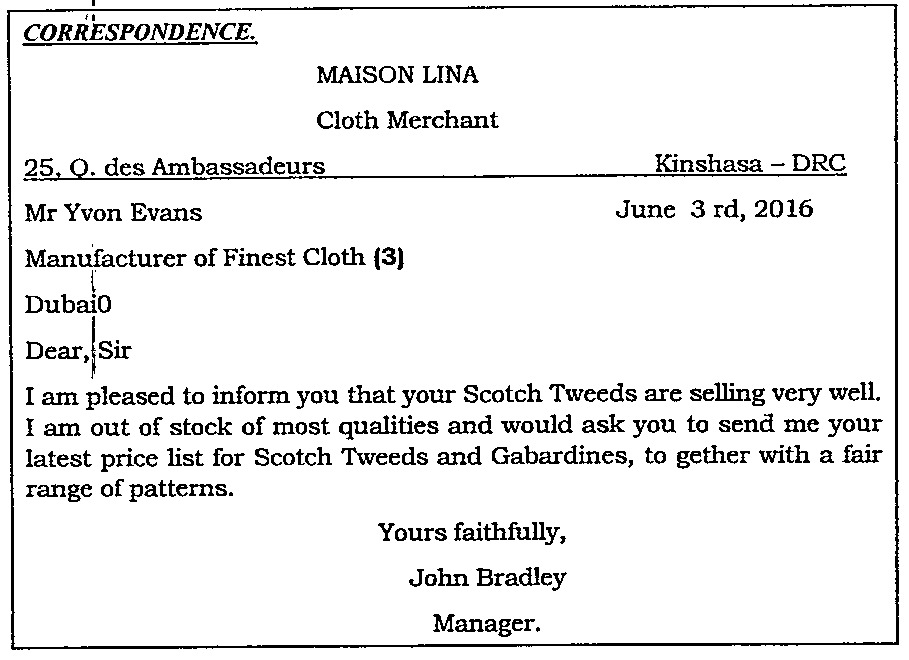
7. John Bradley’s letter to Yvon Evans is:
Bonne réponse : b. an inquiry
Explication :
Dans la lettre, John Bradley demande :
➡️ “your latest price list for Scotch Tweeds and Gabardines”
Une demande de prix = inquiry (demande de renseignements).
Ce n’est ni une commande, ni une offre, ni un règlement.
8. The numbered part (3) stands for the:
Bonne réponse : c. insides address
Explication :
Le numéro (3) correspond à :
➡️ “Manufacturer of Finest Cloth, Dubai”
C’est l’adresse du destinataire, appelée inside address en correspondance commerciale.
Ce n’est pas une salutation, ni une pièce jointe, ni une clôture.
9. Indicate the sentence which gives references concerning an applicant:
Bonne réponse : a. I enclosure a copy of the characters granted by my former employers.
Explication :
Une référence dans une candidature = document attestant :
du sérieux,
du comportement,
des compétences du candidat.
L’option a mentionne explicitement :
➡️ “a copy of the characters granted by my former employers”
→ c’est bien une référence professionnelle.
Les autres phrases parlent de disponibilité, d’ambition, de salaire ou de politesse, mais pas de références.